


Society is full of behaviors that range from annoying to intolerable. Skateboarders skate, dogs pee, and delivery workers charge their e-bike batteries in risky places.
We might think to prohibit these behaviors, whether through signs, fences, or laws. However, in situations where there is no place for the behavior to go, there is another powerful option: redirect it to a designated location.
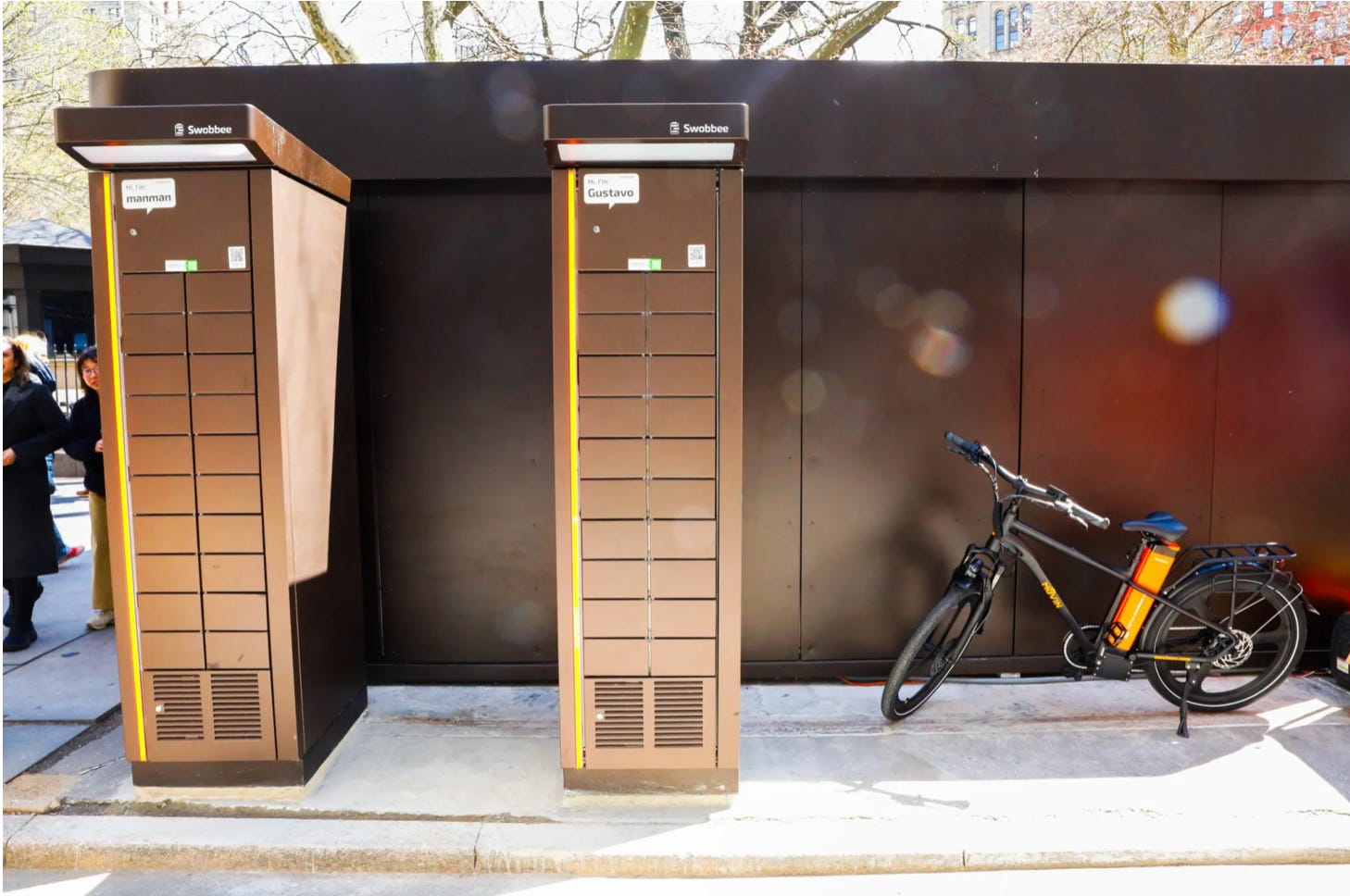
A few weeks ago, New York City opened its first deliverista hub outside City Hall Park, with more planned. It offers NYC’s roughly 80,000 app-based delivery workers, known as Deliveristas, a 24/7 rest area and recharging station for their phones and ebikes. However, it also serves another purpose: with its amenities, it pulls Deliveristas into one place. If it goes according to plan, this will not only make their lives easier, but clear up sidewalks, reduce battery fires, and allow for more effective outreach.
By examining the logic behind this, we can analyze when and how this kind of intervention works.
When There Is Nowhere Else for Behavior to Go
We often prohibit behaviors without giving them anywhere meaningful to go.
There is a civic design pattern hiding in plain sight: In situations where a persistent behavior creates public conflict despite efforts to suppress it, managing it spatially benefits those doing the behavior, those upset by it, and those attempting to manage its externalities. When the situation and intervention align, this works remarkably well.
We know this logic from skate parks. Skateboarders, if given nowhere to go but still interested in recreating with their friends, do tricks in family parks creating “public disorder”. Since prohibition doesn’t stop them, and we want them to be able to recreate, we create skate parks with half pipes. Now they have a better place to skate, and the other park users have the quiet family park they wanted.
This highlights an important success criteria: the alternative space has to be genuinely desirable. Creating a skate park with a half pipe produces a space that skaters genuinely want to use, causing all parties to benefit and not requiring enforcement. While some bad faith actors might still use family parks, most will do something that genuinely improves their experience.
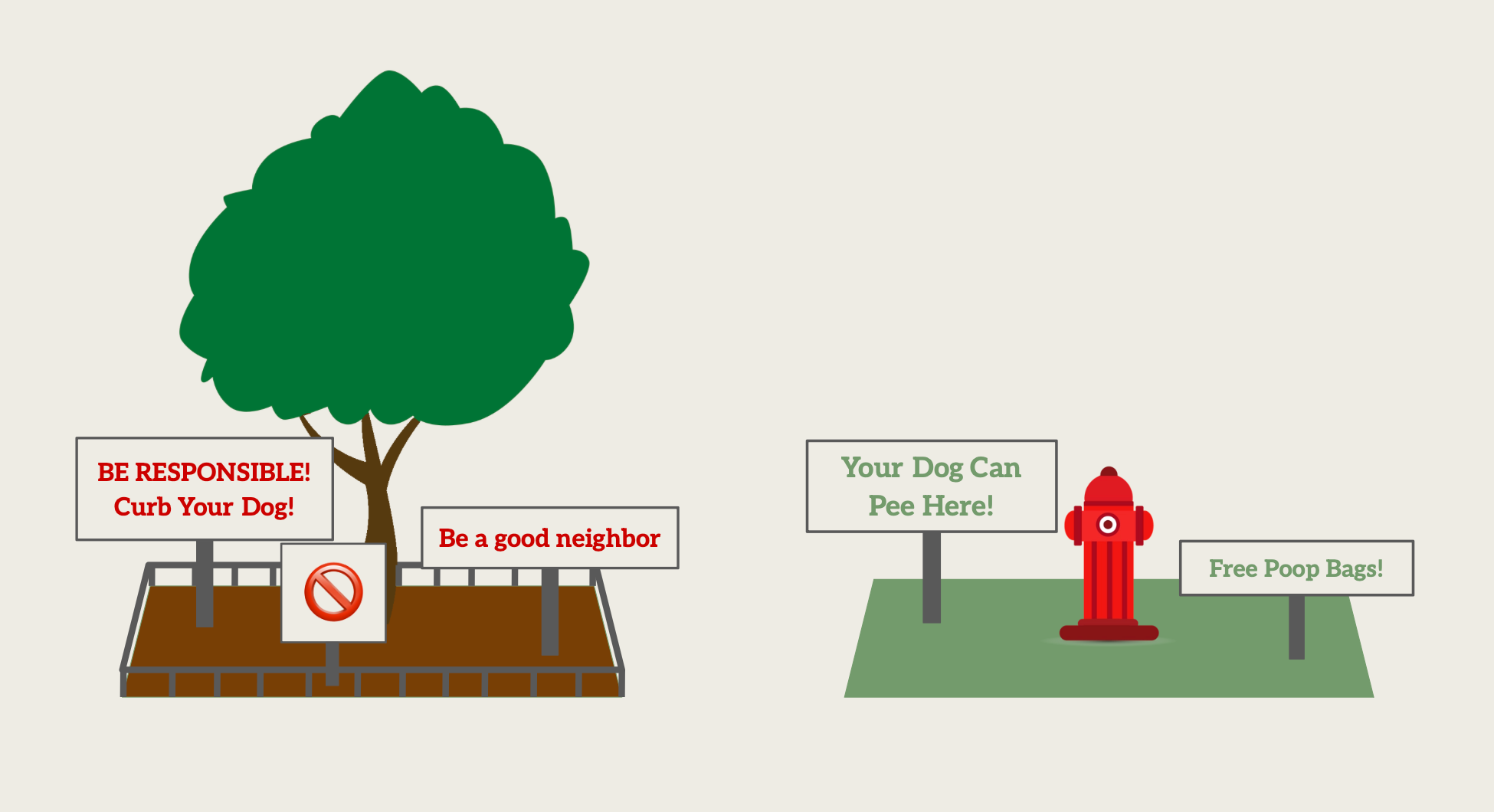
Let’s take another example: the dog rest area. Currently dogs in NYC are told many places not to pee without being told a meaningful place to pee.1 The result is the scent of baking urine in the summer and pee soaked tree beds. If we instead provided dogs a place to pee, that they actually used, we could hose it down easily and it would smell less than if the pee was not centralized to begin with.
This illuminates another strength of this logic: Concentration creates a new opportunity to mitigate the negative externalities of the behavior.
When Centralizing Fails
Providing a persistent behavior a place to go has the potential to benefit every party. However, real world circumstances often get in the way. The new location provided might not attract the desired group, or the centralization can work perfectly but be infeasible for external reasons.
We can see this in the occasional disregard for protected bike lanes. Protected bike lanes attempt to pull biking behavior into a safer and more orderly space by providing bikers a place to go. This is also intended to ensure that bikes don’t end up on sidewalks or going the wrong way. However, New Yorkers can attest to the fact that, while most bikers use these lanes, it is still extremely common to see bikers on sidewalks, in the car lanes, or going the wrong way down a bike lane despite a nearby lane being in the right direction. Even when a place is provided to accommodate a behavior, it will not always be used. In these situations, unfortunately enforcement might become necessary.2
Another failure mode can be seen in season 3 of “The Wire”. Major “Bunny” Colvin is a Baltimore district commander pressured to lower his crime numbers. He can’t arrest his way out of the drug trade. So, he finds a cluster of abandoned blocks at the edge of his district and tells dealers they won’t be arrested there. As the buyers follow, they leave the residential streets clear. Public health researchers show up and start running needle exchanges, blood testing, and condom distribution. By its own operational logic the experiment was successful, but once City Hall discovers the experiment, it collapses under political and institutional pressure.
Centralization is not always morally or politically neutral. As behaviors become more harmful, contentious, or stigmatized, the ethics of concentrating, rather than suppressing, them become significantly more complicated. As we can see, even when the logic accomplishes its goal, it can fail for other reasons.
Another reason centralizing might fail can be seen in the example of the Deliversita hub: In a moment when immigrants are rightfully wary, the largely immigrant Deliversita population might not want to be concentrated. Even when the perks are there, there can be unrelated risks of concentration.
A Design Question
Cities will continue to face behaviors that persist despite deterrence. It is essential to understand why, when, and how we should accommodate them. While we shouldn’t accommodate every persistent behavior, we should stop reaching for prohibition before asking where the behavior could go instead.
Next time you notice a persistent behavior creating conflict, ask yourself:
What harm or externality are we trying to reduce?
Why does the behavior persist despite deterrence?
What need is the behavior meeting?
What infrastructure could pull it somewhere more manageable?
Why would people voluntarily choose that space?
What becomes easier once the behavior is concentrated: outreach, services, safety, maintenance?
What moral or political risks are created by concentrating it?
More times than we give it credit for, the question is not whether behavior exists, but whether cities shape where it happens.
The ability to take the logic of one intervention and use it to derive another is a loop multiplier I call “Design Logic Imagination”.
I say unfortunately because ideally this infrastructure changes behavior solely through capital expenses without requiring manpower.