


The Problem: Social Permission
As we get ready to leave the basketball court, I hesitate. Black plastic bags and empty Arizona bottles are scattered along the edge of the court. Should I just walk around and pick them up quickly? After all, the trash can is right there, but there are a lot of people around. I decide not to.
We often frame the problem of clean public space as one of litterers behaving badly. That framing pushes us toward solutions aimed at stopping bad behavior. But there is another way to look at it: what if the real opportunity lies with people who might be willing to pick trash up when they notice it? Even if only a small number of people acted on that impulse, many spaces could quickly become cleaner.
I believe this is a problem of social permission. Social permission is not what society formally allows, but the unwritten structures that inform what behavior we think is acceptable. So how do we create social permission? Contrary to popular belief, it doesn’t just come from the ideas in our head, but also from the physical environment helping us act in new ways. What if instead of trying to persuade people, we changed which actions were visible and easy?
The Solution: Visible Civic Affordances
Visible Civic Affordances
Small tools or features in public space that make pro-social behavior easy, visible, and socially legitimate, helping new norms emerge.
I just used a big word: Affordances. Affordances are just the characteristics of an object that suggest how it can be used. A door handle invites pulling. A bench invites sitting. A trash grabber invites cleaning.
Trying to create a norm through an instruction often creates resistance. Visible civic affordances work because they show the behavior through humans. When someone sees another person easily performing an action in public space, it signals that the behavior is possible, acceptable, and even expected. Over time, this can spread and produce social norms.
In the context of parks, a trash grabber might be a good small example. In the same way that having a shovel in a blizzard gives us the option to clear a crosswalk, a trash grabber changes what actions feel available to us. We no longer need to bend down or touch garbage to pick it up. However, what the tools presence suggests might be even more important than the new ways to pick up trash it allows.
Objects are not neutral. They signal what behavior belongs in a place.
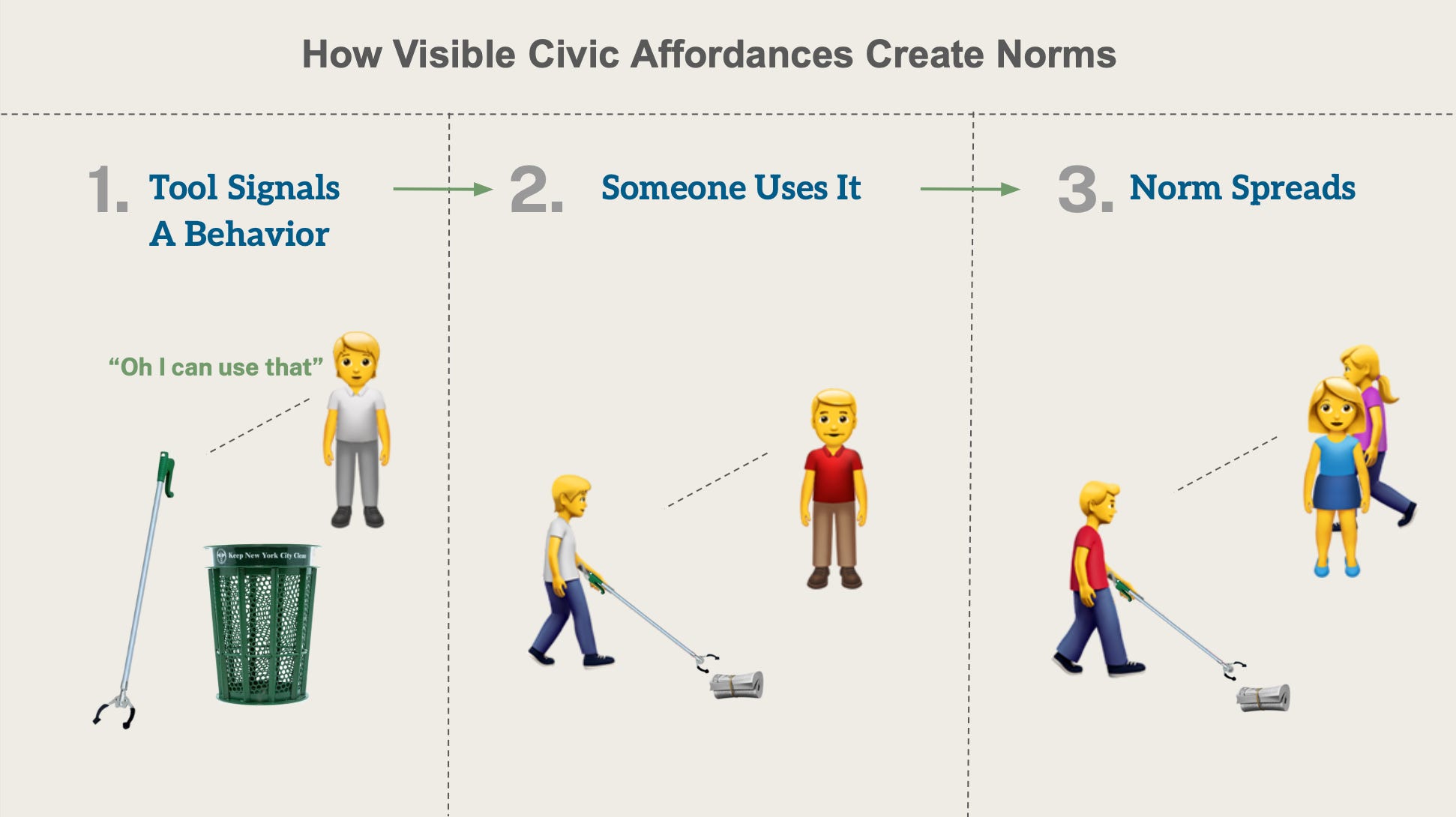
A trash grabber advertises that picking up trash is an allowed, if not expected, behavior in the park. When a behavior becomes visible and easy, it can spread socially. Artifacts can create social permission. However, many interventions like this don’t end up achieving their goals. What determines if they work or not?
Why Some Interventions Change Behavior and Others Don’t
There are many ways we can think about what makes a successful intervention (and I will explore more of them in the future), but for now we will use a simple model: behavior spreads when it is a) visible and b) easy to adopt. When a behavior is invisible or difficult, it rarely spreads.
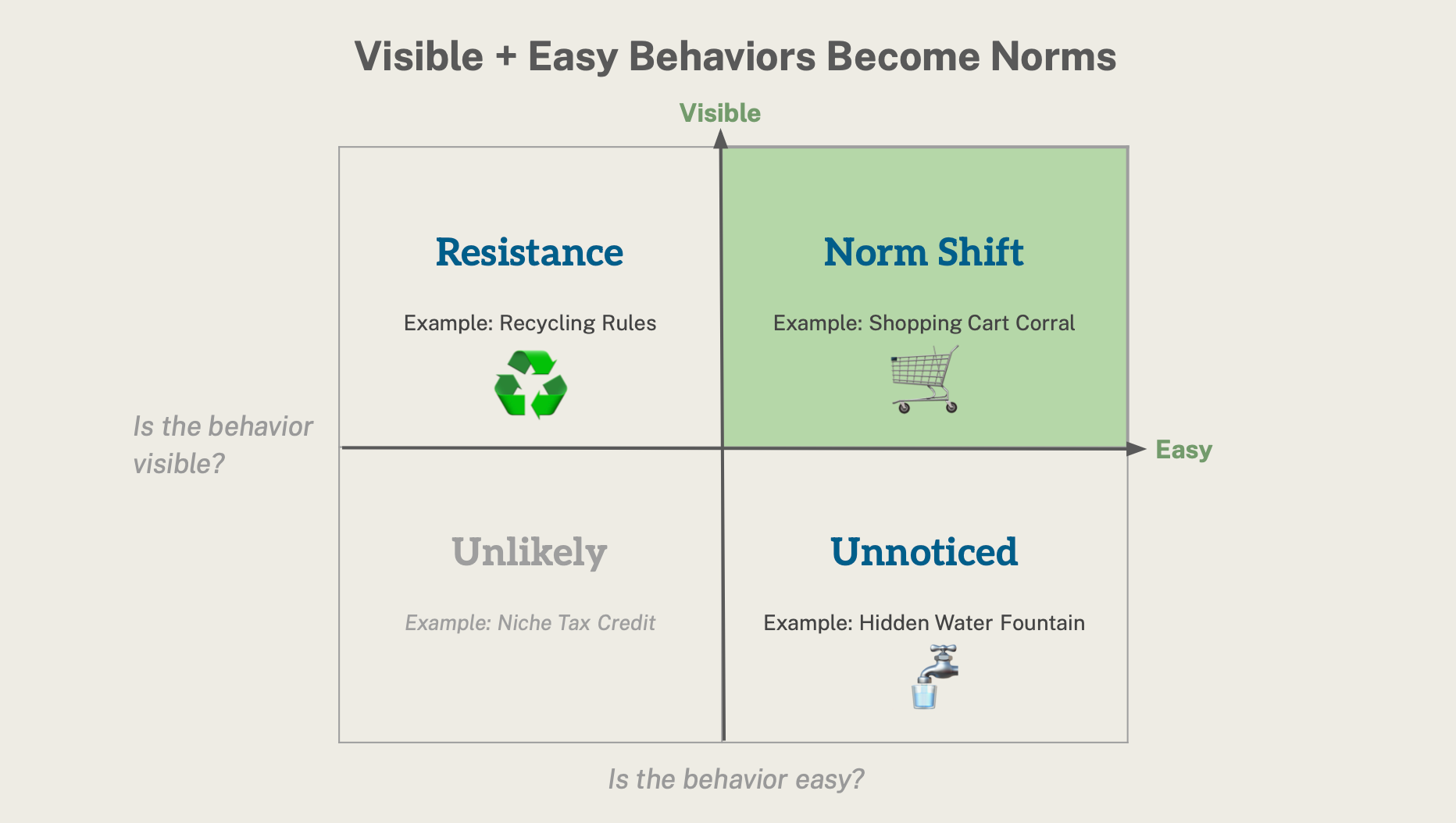
Grocery stores used this principle decades ago when creating shopping cart corrals (the place you return a cart) by making the socially expected behavior both visible and easy. This example is so intuitive that we might not even think of it as design intervention. They advertise themselves, sit right where people exit stores, and don’t make anyone’s life harder. As a result this is such a norm that we can’t imagine a world without it. When tools make a behavior visible and easy, that behavior can become the norm.1
How does this apply to our trash grabber example? Well, depending on how it is placed, a trash grabber sitting unused in a park might have low visibility, but once one person uses it, the behavior becomes extremely visible. Picking up trash is not a frictionless behavior to add to your routine, but unlike a shopping cart corral, it doesn’t need to be. We are specifically targeting only the people who would pick up litter but rarely do so.
In the context of New York City, this is not meant to argue that we don’t need containerization, stewardship programs, or marketing campaigns. Instead, I’m arguing that trash grabbers can help those other interventions succeed by recruiting already motivated New Yorkers to help and making participation visible and easy. As a bonus, the visible act of cleaning may itself discourage future litter.
A Simple Experiment
Promisingly, this idea is cheap, easy to set up, and easy to undo. In fact all we need to do is install one and see if people use it.
This would require picking a park, partnering with a group like a Business Improvement District, park conservancy, or neighborhood group, and finding a place to put it. For our “before” condition we would observe and evaluate existing litter levels and park user behavior.
Then for our test we would install a trash grabber with a sign like “Keep Our Park Clean!” and attach a sticker that says “if found please return to [this] park!”
For one month, through observations we can see if people use the grabber, walk past it, pick up trash without it, or even steal it. Conversations with park users would provide qualitative feedback.
You might immediately think that these will get stolen. As a New Yorker, I agree that this is definitely possible or even probable, but that it is still worth testing. Site selection and placement within the park would play a large part in the likelihood of theft. This should be viewed as a part of the experiment and accounted for with multiple backup grabbers. For the sake of future policy decisions it is worth knowing if a trash graber accomplishes its goal, and if it does get stolen, how long it would take before someone took it. Luckily this is closer to a $50 question than a $5 million one.
How can we increase our civic affordances?
Trash grabbers are just one prototype that emerges from this way of thinking. If many people already want cleaner parks but lack social permission to act, the question is not just how to stop litterers. It’s how we can design public spaces that make helpful behavior visible and easy. Objects are not neutral. They signal what behavior belongs in a place.
In a previous essay I explored dog pee rest areas as another example of a visible civic affordance. When first installed, that intervention would likely be highly visible but have high friction. However once we redirect dogs there it will become very easy as dog pee creates a reinforcing loop for other dogs at that location.
I love the idea of at least testing this out in just one park to see how they’re used/not used. If it were successful, I’d also love to see how it cut down on time spent by park staff picking up litter—could be a lot of time/money saved!
This is a good idea. The cost of the tool might pale in comparison to paid parks employees, who are understaffed as is. Don’t wait for business district permission to do this. Put a claw out there with a sign and observe what happens for an hour or two.