


In a previous essay, I described a small experiment on my block that redirected dog pee away from street trees. The behavior changed almost immediately because the intervention worked with a reinforcing loop rather than against it.
This post breaks down the design logic behind that experiment and shows how it could be tested elsewhere. If you’re curious about the design thinking behind the idea, you’ll find the framework here. If you’re someone who wants to try something similar in your neighborhood or organization, you’ll also find a practical pilot plan.
The Design Logic Behind Dog Pee Behavior
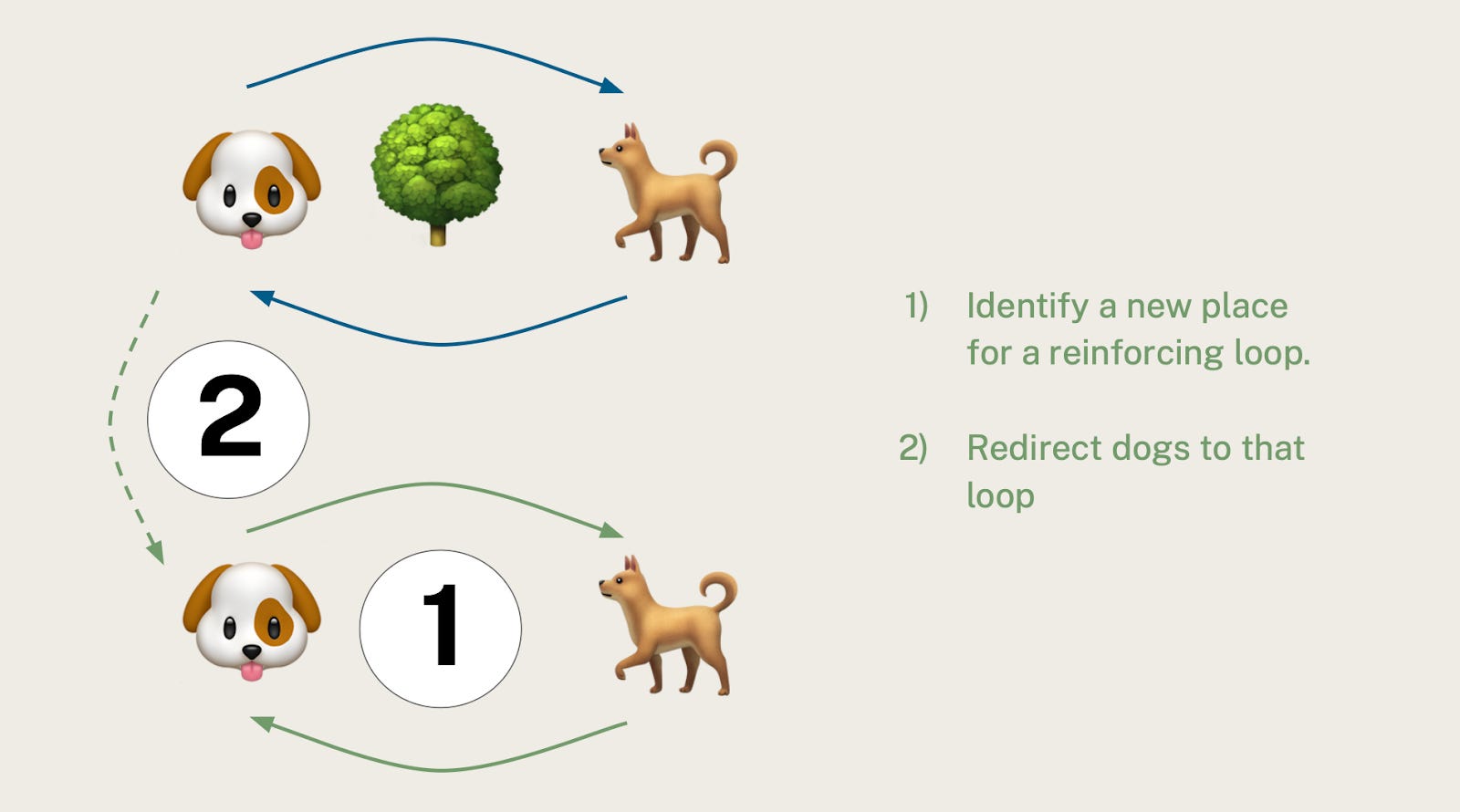
Dogs tend to pee where other dogs pee, which is known as countermarking. This produces a reinforcing loop. That means an effective solution will establish a new reinforcing loop and then redirect dogs there.
Core Principle:
If we try to fight against a self-reinforcing loop, we will face heavy resistance.
If we play into the self-reinforcing loop, solutions will scale naturally.
While addressing this core dog behavior is the smoothest solution, we can also look at the reasons humans let their dogs pee on trees: or as I call it, the care gap. Most of us care about trees on a social level, whether for climate, wellbeing, or budget efficiency. However, individuals aren’t acting in alignment with that value. There are 3 ways we can address a value gap: resolve it, bypass it, or transform it. These apply differently to every situation and are not created equally. In this case, to be effective they must work in the constraints of our reinforcing feedback loop. Curb Your Dog signs and tree guards do not work because they try to fight the loop instead of playing into it.
Three Ways Cities Can Address Dog Pee on Trees
Educate Dog Owners
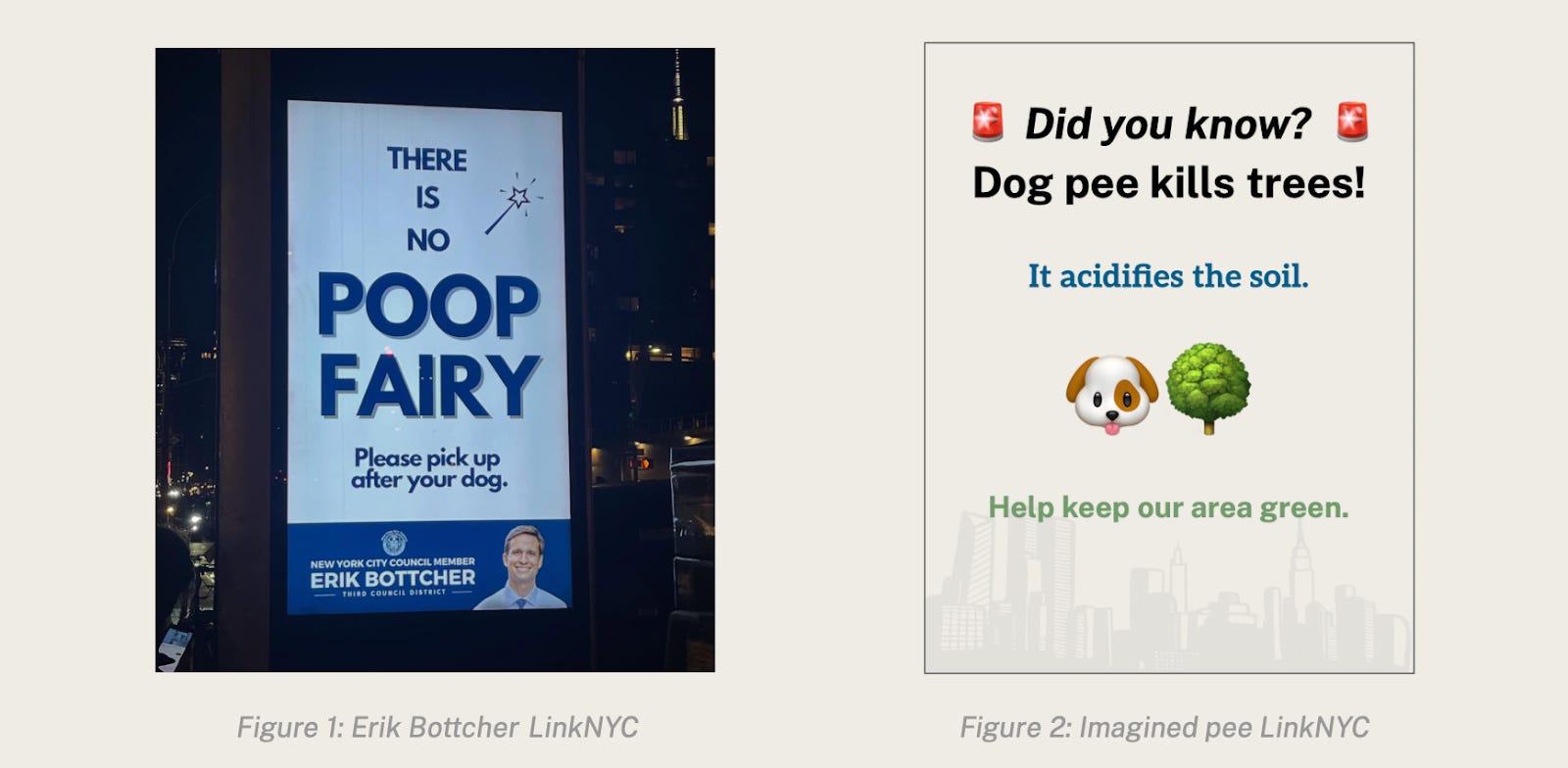
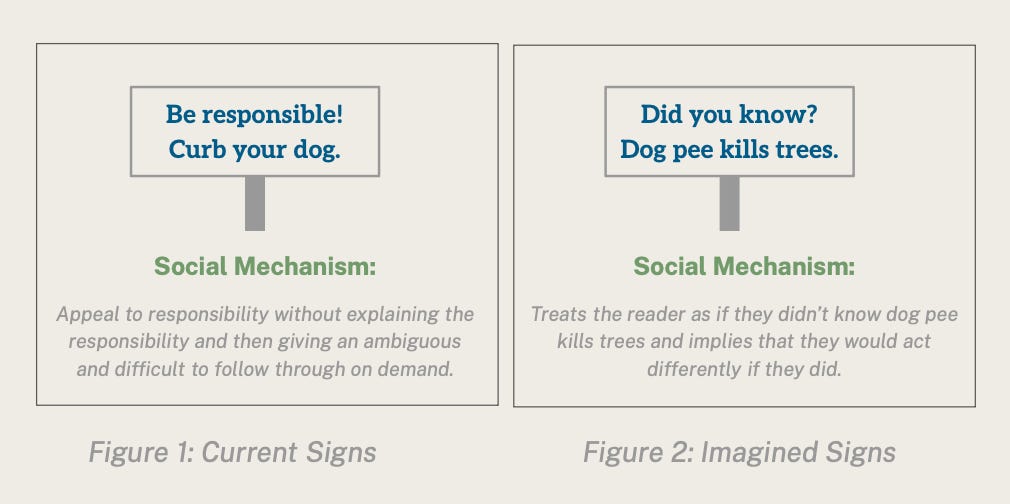
We could try to resolve this care gap by educating people as to how their individual behavior of letting dogs pee on trees is in conflict with their societal value of healthy trees. This assumes that knowledge is the gap, and is likely not enough to solve the problem because it trys to fight against the loop. It is still has value as a way to reinforce the new loop if set up.
What should education be like?
If this is an education strategy, it has to fit on a small tree sign and actually change behavior. That means:
Plain language.
Catchy and memorable.
Short enough.
Explains that it is bad.
Here are potential LinkNYC and Tree Bed Sign designs that align with this:
Redesign Tree Beds
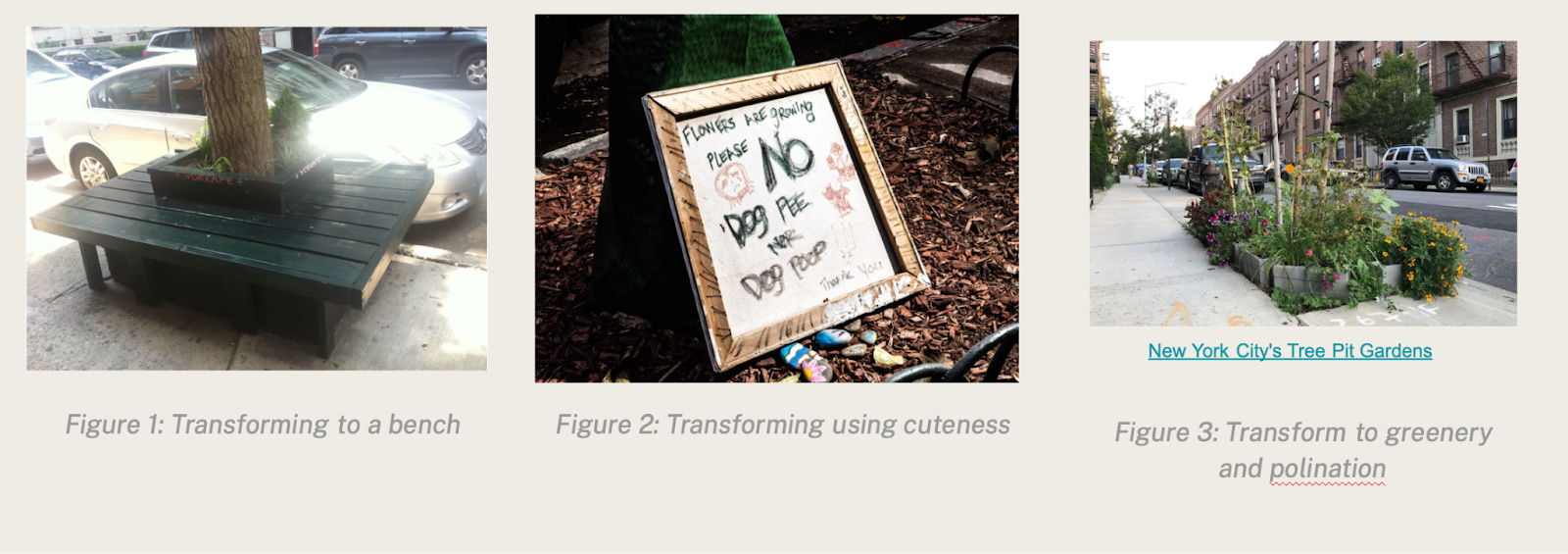
Instead of making people care more about trees, we could try to transform the tree bed into something they do care about. This still asks people to care, but about something other than the tree. This lets us get creative, however it still trys to work against the loop and as a result is not a solution. It could however support redirecting dogs to a place to pee.
How can we make a tree bed a place someone wouldn’t let their dog pee?
This requires identifying things people would not let their dogs pee on:
Seating: Placing a bench, table, or chairs around a tree bed.
Something Cute: Emphasizing that a child cares greatly about the tree.
Beautiful Flowers: Beautifying the tree bed and then guilting the walker.
Provide a Dog Pee Area (The Most Promising Solution)
Instead of making people care, we could bypass caring by instead providing a more convenient place to bring your dog. Because dogs pee where other dogs pee, if we give a place for dogs to pee and give owners a reason to bring their dog there (free poop bags, Signs that say “your dog can pee here”, etc) it will take care of itself, as I witnessed on my block.
What would a dog rest area need to be like?
This would need to be somewhere dogs want to pee that their owners will bring them. This means:
Be Accessible
Advertise itself well. People need to think about bringing their dog there.
Be maintainable
Be cheap and easy to replicate
Not require enforcement
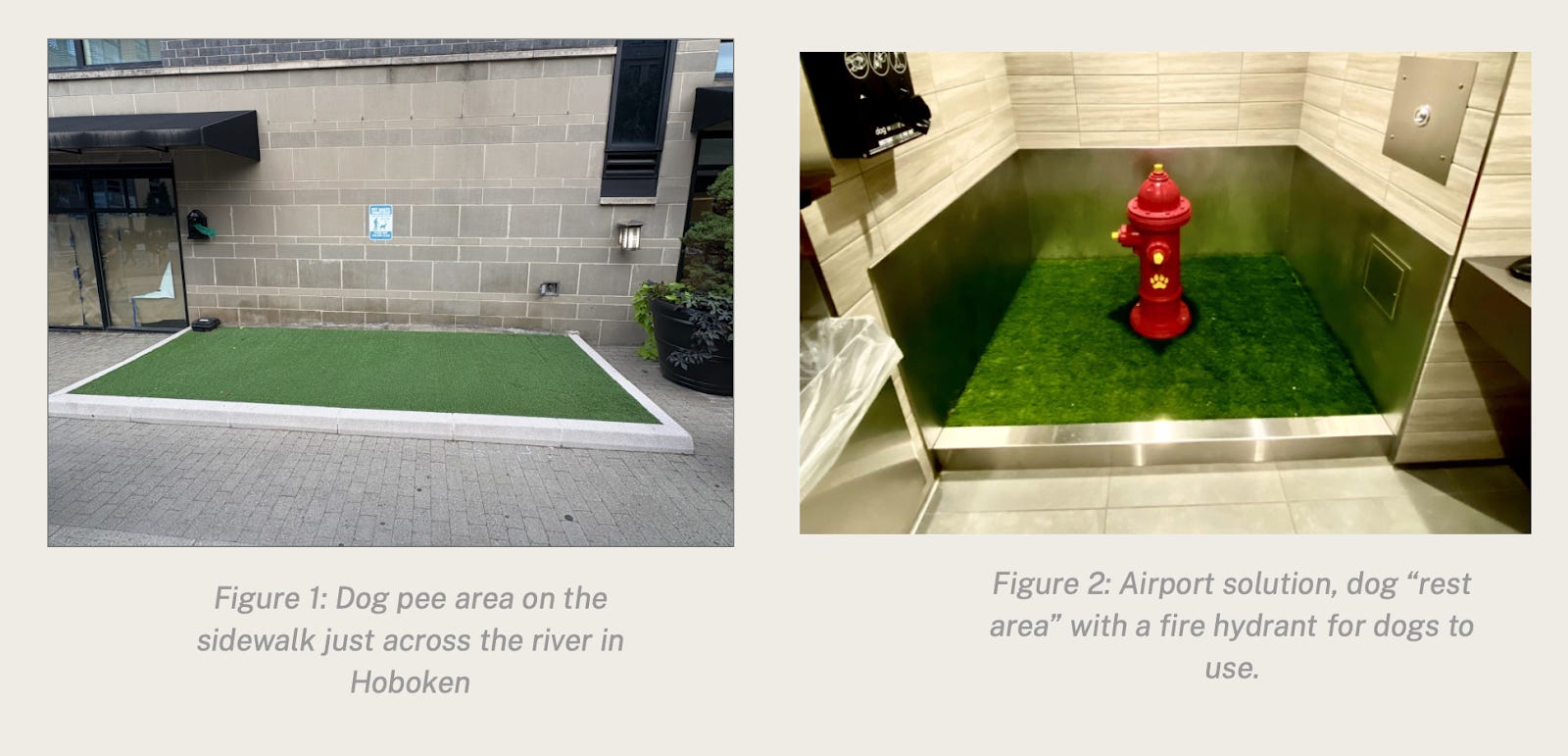
This is not a ridiculous idea, it is done in airports as well as just across the river in Hoboken.
Bypassing works with the feedback loop, and therefore is our core solution.
How to Run a Dog Pee Pilot in Your Neighborhood:
Who can actually do something about this? There are many players in the fragmented NYC tree ecosystem.1 However, I believe that a Business Improvement District (BID) interested in public realm innovation would be the most promising pilot target, and I plan on reaching out to a few to talk about it. (If you work at a BID and are reading this and are interested or know anyone, let me know!)
1 month pilot with a BID. Pick a sensible location, set up a pilot, advertise, monitor, iterate, evaluate.
Choosing a Pilot Location:
High dog density
Maintenance capacity
Near running water + storm drain
Ability to oversee
Visible signage
Visible site
Not served by existing dog run
Near trees so we can track change
Materials:
4’x4’ Turf square + Replacement
Sign saying: “Your dog can pee here.”
Addittional advertising signage nearby
Dog waste bag dispenser
Hydrant or visual anchor
Maintenance partner (Ideally near a hose and drain)
Volunteer or staff to inform dog walkers of pilot
Estimated Cost:
2 4’x4’ pieces of Turf: 80$
Sign: 30-50$
Additional printed signage: 5$
Bag dispenser: 20-40$
Total: Approximately 175$
Maintenance:
Daily - Weekly rinse, depending on conditions
Volunteer (me) or staff to tell people in the area of the pilot and ask them to try bringing their dog there.
How to Measure Success:
Reduced staining at adjacent tree beds (done by pre/post trial pictures? Or just watching for an hour a few different days and counting?)
Visible use within first week
Dog walkers redirect voluntarily
If You Want To Try This:
Curious Reader:
Keep an eye out for opportunities in your area and see how you can get involved! Look for potential feedback loops and reach out to me if you have any ideas you want to bounce around. Additionally, feel free to try my signage or transformation ideas and let me know how they go.
Local organizer:
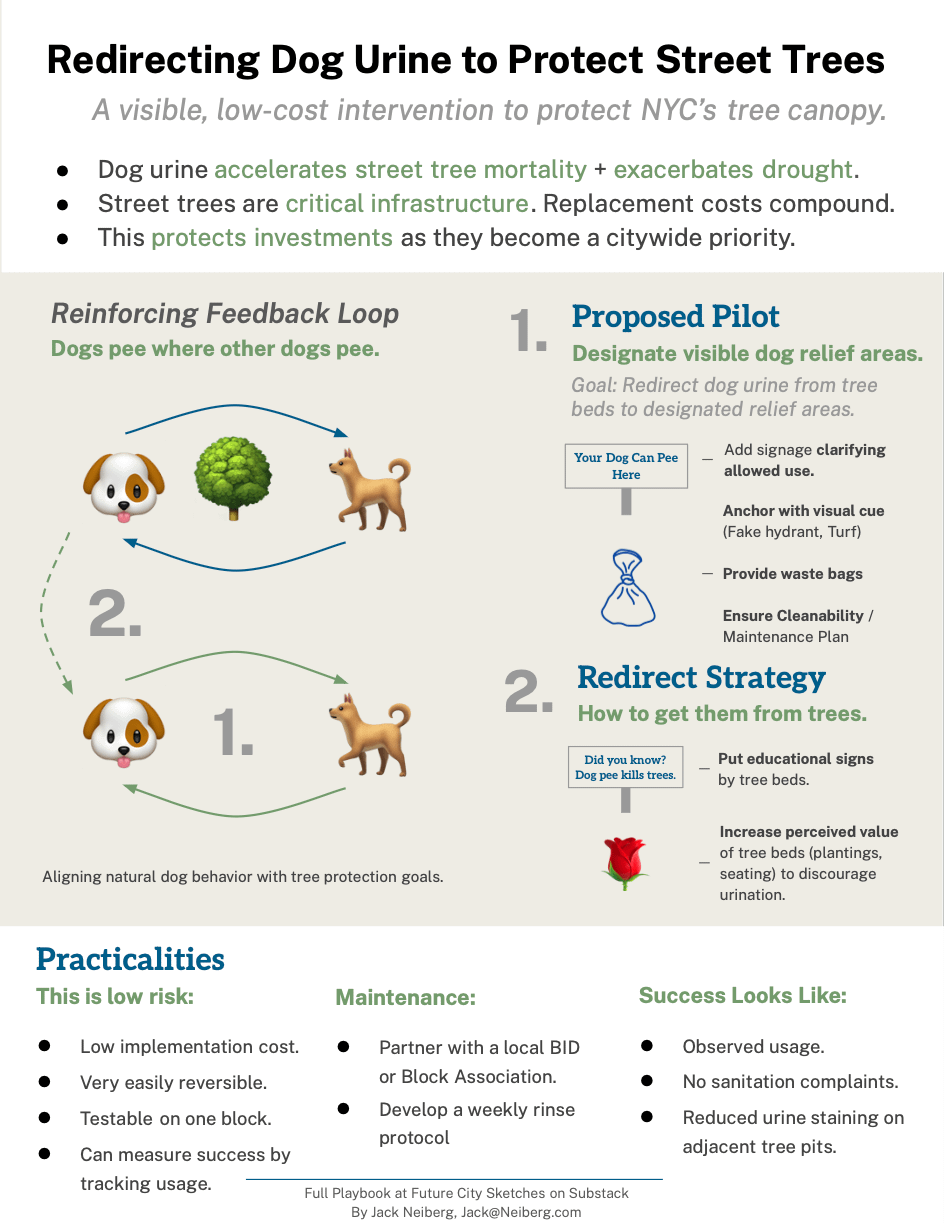
Try a small pilot with a block association or BID. Here is a one-pager I developed advocating for this proposal, feel free to use if it is helpful.

City staff, BID, nonprofit, etc:
Reach out if you’d like help designing or evaluating a pilot, or just to bounce ideas!
Email me at Jack@Neiberg.com
Just to name a few: NYC Parks, Business Improvement Districts, individuals, neighborhood groups, block associations, nonprofits contracted by council district discretionary funds, park conservancies, Privately Operated Public Spaces, cemeteries, NYCHA campuses and probably more.
I found this very interesting! Other potential implementation partners: dog enthusiasts. A woman on my mom’s block keeps a treat box in front of her home for the neighborhood dogs. This type of person might be more willing to invest in this type of pilot than BIDs, though it might be tricky to find them—they need the curb space, the cash, and the enthusiasm for dogs/design!