


The physical world we’ve built has a chokehold on what we think is possible. This is because infrastructure creates self-reinforcing systems that shape what feels possible.
To escape this chokehold, we need to understand how it works, and how we can take advantage of it.
What’s Actually Happening
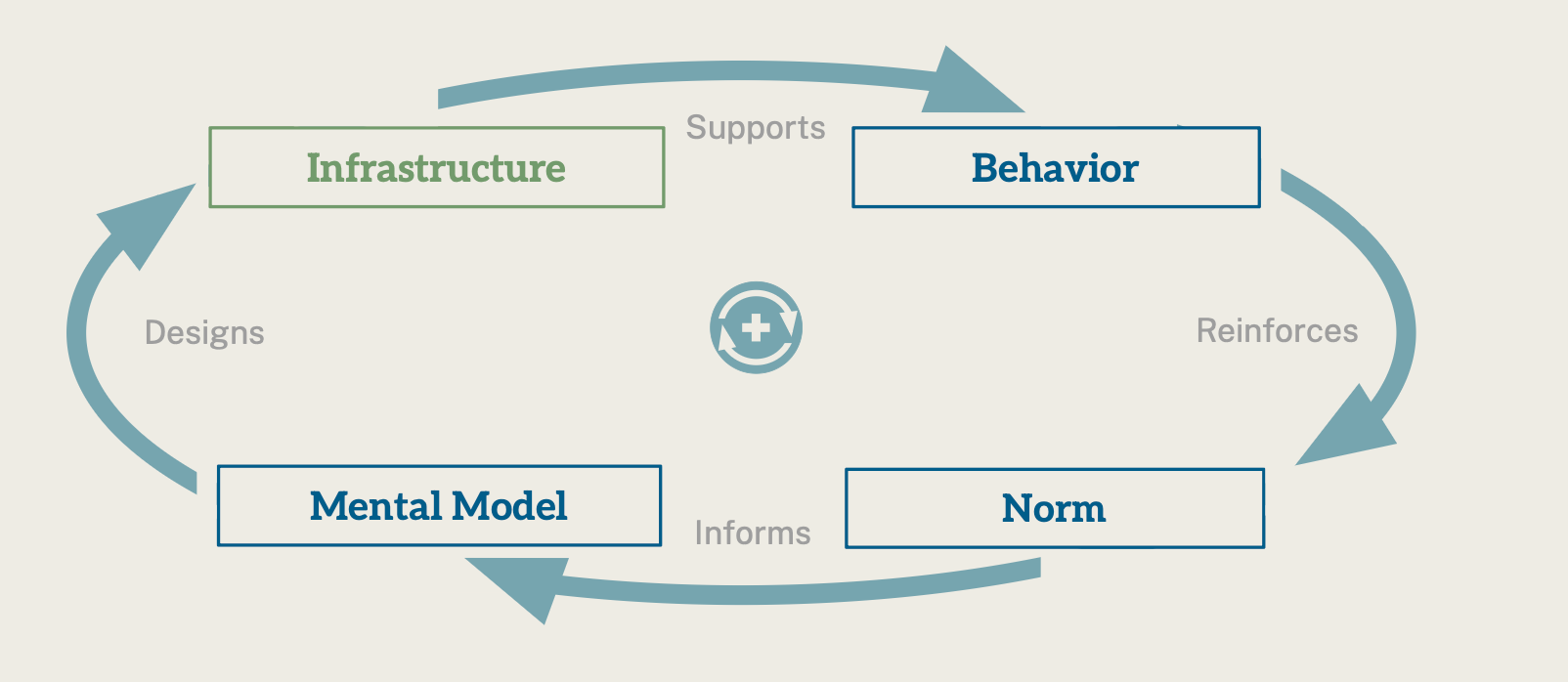
Infrastructure makes a behavior easier ->
The behavior becomes visible ->
The behavior becomes normal ->
Norms shape what feels possible ->
We act on our sense of possibility
Example: A good bike lane doesn’t just allow biking, it makes biking easier, which produces bikers. This eventually makes biking normal, which changes what cities think is possible, which leads to more bike lanes.
I call this the induced possibility loop. It’s the process by which infrastructure creates self-reinforcing systems that shape what feels possible.1
What matters most is what happens after a new sense of what’s possible takes hold.
How New Possibilities Expand
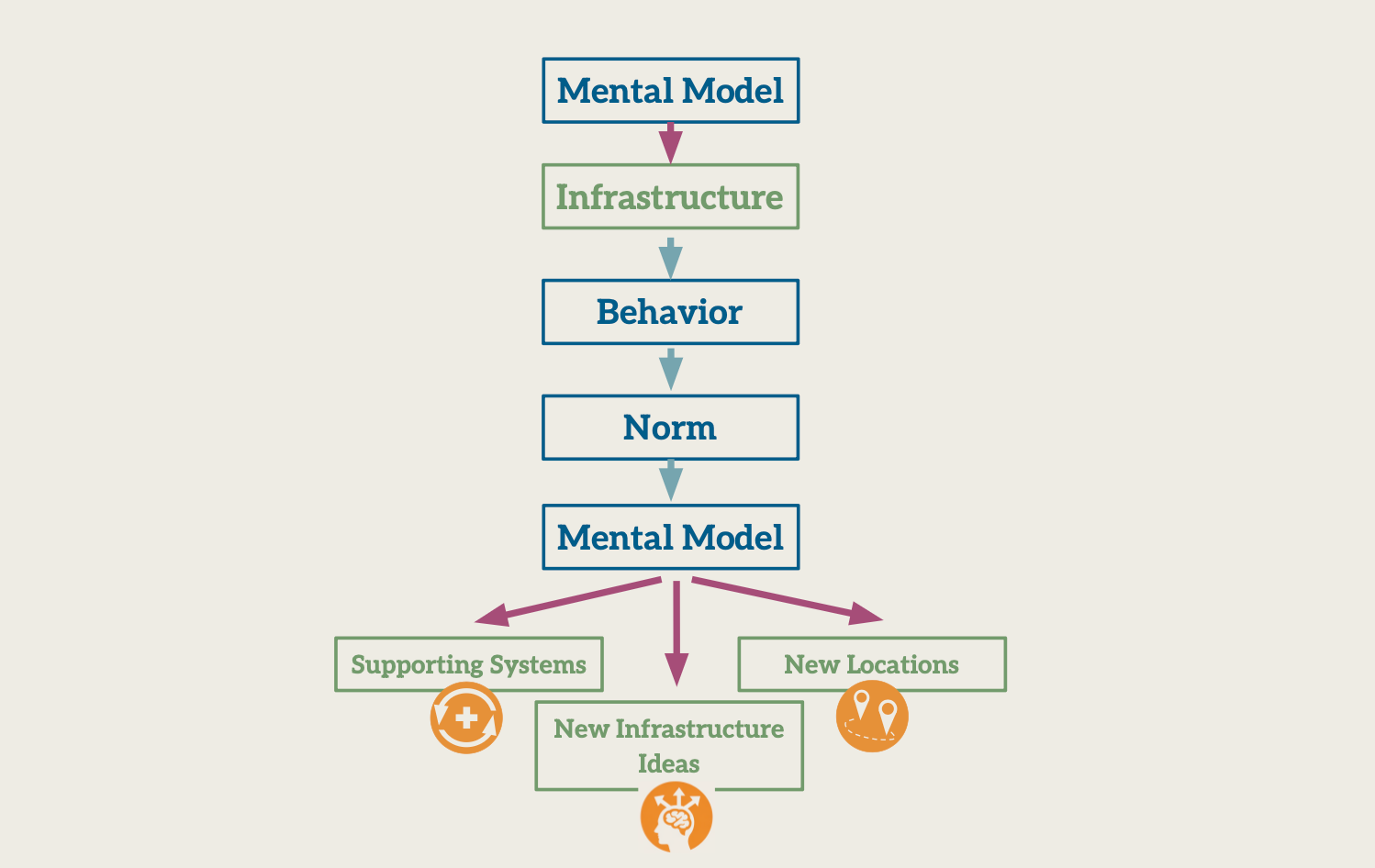
Once a behavior becomes normalized and enters our collective mental model, it expands outward. This expansion tends to take three forms:
Spread — the same behavior appears in new places
Deepening — supporting systems develop around the behavior
Imagination — the underlying logic gets applied to new domains
1. Spread (New locations)
The original infrastructure is built in new locations as it travels as a best practice.
Example 1: Dutch style protected bike lanes are built in Seattle and Cambridge.
Example 2: After congestion pricing worked in cities around the world, it spread to NYC.
2. Deepening (Supporting Systems)
Supporting infrastructure is produced that is demanded as people pick up a new behavior.
Example 1: As people bike more, bike parking lots and bike rental services are established.
Example 2: Higher quality train stations and better train service are demanded to serve those affected by congestion pricing.
3. Imagination (New Infrastructure Ideas)
When one piece of infrastructure expands what people think is possible, it can create demand, and belief in the possibility of entirely new kinds of systems.
Imagination is uniquely powerful and interesting because it is not confined to a specific domain or behavior. It’s about applying the underlying design logic to a new domain.
Example 1: The adoption of bike lanes changes how people experience streets. Once streets feel like places for people, not just cars, ideas like outdoor dining or more green space start to feel possible.
Example 2: The success of congestion pricing changed how people think about pricing as a policy tool. Once you’ve seen pricing change behavior at scale, extensions seem obvious. Cap and Invest schemes, charging for parking by demand, and extended producer responsibility all start to feel like obvious next steps.
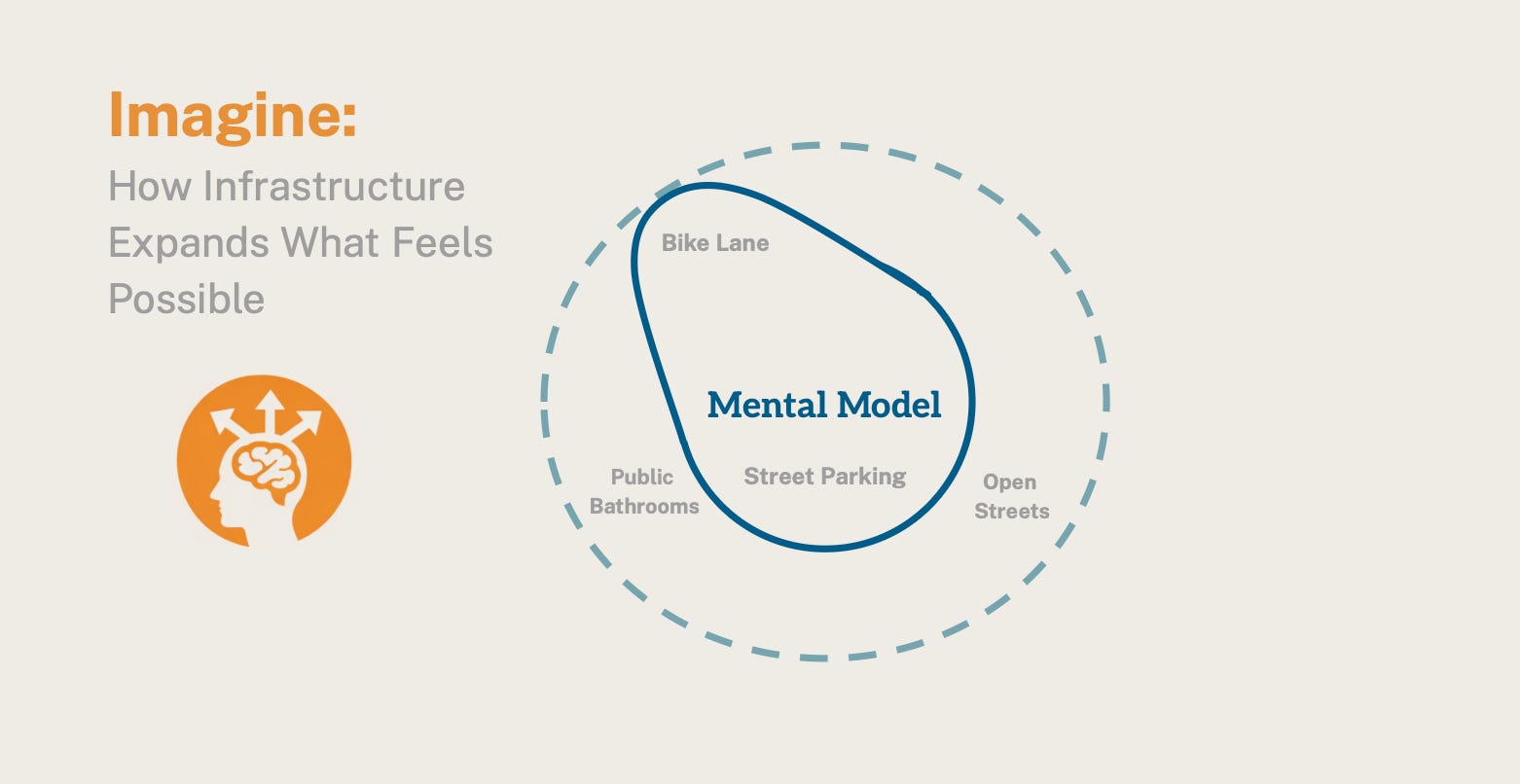
One change in infrastructure can turn into many as each one shifts what people expect and demand next. Good interventions can expand what feels possible.
But this same process can also trap us.
Why So Little Feels Possible
The loop is currently clogged.
With the same designs everywhere, we begin to mistake them for inevitabilities. So little feels possible in our country: we are dominated by highways and suburbs, spanning a whole continent, which have reinforced the same behaviors, norms, and mental models for almost a century. If you’ve never seen anything else, this might just seem like the way the world has to be.
Even when people know more is possible, they often can’t change the infrastructure. Political and bureaucratic incentives often prevent new infrastructure from being built or scaled even when what feels possible has shifted. We continue to invest in “just another lane” when we understand better alternatives exist.2
But hope is not lost.
Despite the current suffocation our collective imagination, the right change will still multiply greatly. We can re-expand what feels possible.
To do this we have to make sure we are investing our time and effort in the right places. Many attempts at social change focus on shifting norms or making awareness without changing the underlying environment. These efforts often stall because they work against the loop, not with it. In fact we even know what to do: If a desired behavior isn’t happening, change the infrastructure. We overlook that culture is, in many cases, downstream of what is easy.
Messaging alone doesn’t change behavior at scale.
Infrastructure does.
How to Use The Loop
So where should we look to make change? The loop guides us to some natural starting points.
Is there pro-social behavior happening despite infrastructure?
If so, if infrastructure were to enable it there would likely be a massive explosion of behavior.
Example: Are people picking up litter despite there being no infrastructure to enable this behavior? If so, that is a sign there is demand.
Is messaging doing all the work?
If there’s a pro-social behavior that demands constant messaging to elicit compliance, that’s a strong signal that the desired outcome isn’t easy enough to comply with given the current affordances.
Example: The amount of “curb your dog” signs in NYC implies a larger systemic problem.
Did an infrastructure change work better than expected?
If so, what working principle could be extrapolated? Are there other domains this could translate to?
Example: After the success of congestion pricing, what other behavior could we apply the mechanism of using pricing to make a behavior more or less attractive?
Examples:
For applied examples, these are two topics I’ve dug in on which focus on making a behavior that could change a norm easier.

Seeing the Loop
What feels possible in the world is stuck because the infrastructure we rely on is stuck, and the way we try to make change often doesn’t work.
Next time you’re going for a walk, try to spot the invisible loops. Once you see it, every street starts to look different.
This is part of Future City Sketches, a series exploring how small interventions can reshape what feels possible in public systems.
I’m working on a deeper write-up of the full model and I’m happy to share if you’re interested!
For a video overview of this topic:
This is not to imply that all infrastructure creates this reaction. It needs to be visible, make life easier enough that it gets adopted, and trigger imagination towards a new possibility. Much more on this coming soon.
Much more on this coming soon.
Your point on relying solely on messaging to drive change reminds me of this tweet:
"If your solution to some problem relies on "If everyone would just…" then you do not have a solution. Everyone is not going to just. At no time in the history of the universe has everyone just, and they’re not going to start now."
The induced possibility loop feels like a breath of fresh air to an otherwise stale and frustrating impasse. Excited to see the rest of the Future City Sketches series.