


Last winter’s snowstorms left New Yorkers with an unexpected problem. As the snow melted, something else emerged: an extraordinary amount of dog poop. In the two months following the snowstorms, 311 saw a nearly 36% increase in reports of dog poop compared to the previous year.
Failing to curb your dog is illegal, and violators face a $250 fine, but the fine does little to change behavior. Recognizing this, the city council recently passed a three-law package known as the Safe and Clean Outdoor Ownership Practices (SCOOP) Act.
Government officials agree change is necessary. A representative from the Sanitation Department testified that enforcement officers would have to catch the owner while leaving a pile behind, which is unlikely to happen. They even tried special patrols in areas with high 311 requests for dog waste, but these have resulted in no fines.
“The chances of someone not picking up after their dog while an enforcement officer is watching is very, very slim,” the representative said. “It is clear that people only leave piles behind when they know no one is watching.”
With nobody to hold accountable, law enforcement has struggled to forge the best path forward. In other communities they have required owners to register their dogs’ DNA, to then swab any droppings and fine the owner. But a system that’s administratively plausible in an apartment complex, bounded community, or even a smaller city is a very different proposition across New York City, not to mention the obvious privacy and political questions created by building a DNA registry of people’s pets. Absent a radically more intensive enforcement system, the Council is trying to intervene elsewhere in the behavioral chain.
What actually causes the poop?
The SCOOP Act treats dog waste on the street as an outcome with multiple possible causes. The same problem can produce completely different solutions depending on how you explain what's causing it.
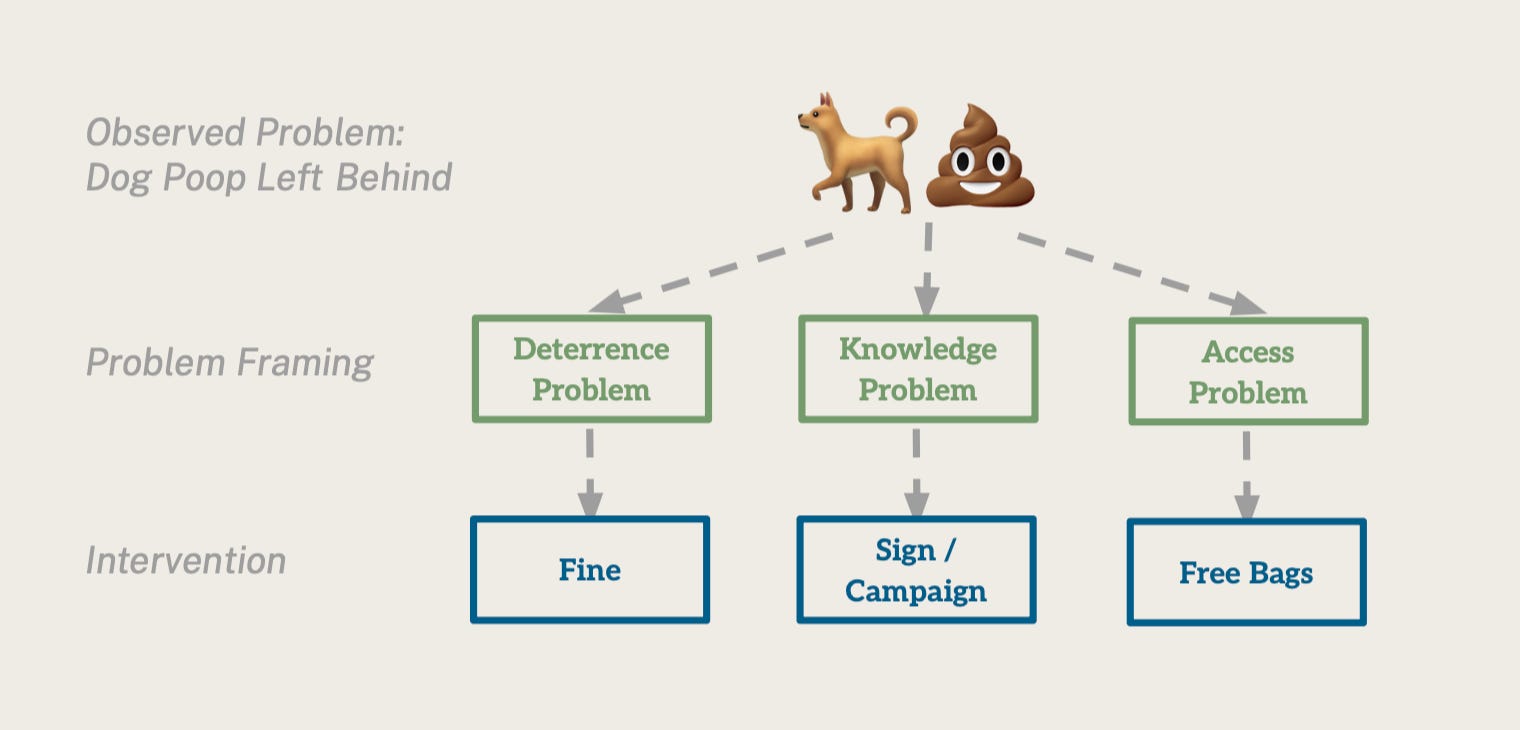
Maybe the problem is that dog walkers don’t have bags. Or a dog pooped twice and the walker already used their bag. Or the dog walker just doesn’t care. By diagnosing the behavior resulting in the dog poop, laws are able to address these specific cases.
Can you educate people into picking it up?
The first law in the SCOOP Act, Intro 0872, mandates the Department of Health and Mental Hygiene (DOHMH) to conduct a three-year long outreach campaign, teaching the public why it’s important to remove dog waste. They will report on its effectiveness after the third year.1
You might assume everyone knows leaving waste behind is wrong. The DSNY agrees, testifying that: “Every dog owner knows what they are supposed to do in consideration of their neighbors. They should do the right thing and pick up after their dogs.” Also adding that they have “done and continue to do several ad campaigns and educational outreach on the issue of dog waste.”
This prompts multiple questions. First, if the relevant agency is already taking action, why pass a law requiring them to do what they already are doing? Maybe it’s to ensure they take action instead of just leaving it up to administrative discretion. But, if the agency reveals doubt that lack of awareness is the problem, why would another education campaign be expected to change behavior?
The package’s next law makes this question even more interesting.
What if people just need a bag?
Intro 0857-2026 tackles a different potential reason why a dog walker might not pick up after their dog: not having a dog bag when they need one. It addresses this by mandating the city to provide free public dog waste bags. This makes sense at first, if you want to pick up after your dog but realize you don’t have a bag, a bag would solve the problem.
So, where will these bags be? The bill requires DSNY to “install no less than 1,200 dog waste bag dispensers on public litter baskets across the 5 boroughs.” But imagine this: your dog poops halfway down a block and you realize you don’t have a bag. The nearest dispenser is on a litter basket somewhere else. How far out of your way are you willing to walk to get one? And will you come back? The effectiveness of the intervention depends partly on distance, but we don’t yet know the behavioral relationship between distance and uptake.
The law is built on a behavioral hypothesis: in this case that making bags available will meaningfully increase pickup. However, it is the city council deciding that this hypothesis should be tested.
Who should design the solution?
We’ve now seen the Council mandate two different behavioral interventions: education and access to bags. This raises a broader question: how much should a legislature specify the intervention it wants tested, and how much should it specify the outcome and leave the intervention to the agency?
There are real advantages to legislative specificity. Legislators are accountable to voters, and legislation can guarantee that an issue receives attention and that the government takes concrete action. Instead of sending a problem into another round of planning, working groups and reports, the Council can require someone to actually do something.
But there is a tradeoff. Requiring a specific action means choosing an intervention before the implementing agency has had much room to experiment with interventions. Giving agencies more discretion creates room for staff with subject-matter expertise and implementation experience to test, adapt, and learn, but it also makes it harder for elected officials to guarantee that anything happens at all.
The Council does sometimes take this more outcome-oriented approach. Int 1065-2023, for example, mandated an Urban Forest Master Plan for achieving 30% tree canopy by 2050 rather than prescribing every intervention needed to get there. The difficult question is how much of the “what” and “how” should belong to each institution.
In practice, though, legislative specificity and administrative discretion aren’t binary. The dog-bag law demonstrates this. The Council chose the intervention and its scale, at least 1,200 dispensers, but left DSNY to prioritize them in areas with the greatest need for dog-waste mitigation. The law then requires an evaluation after several years.
The broader question is which decisions should be made by elected legislators, which should be left to the agencies implementing the policy, and how much room those agencies should have to learn and adapt.
From behavior to operations
The first two laws try to change what dog owners do. Intro 0864-2026 instead asks what we can do with the waste once someone actually picks it up? It’s answer: compost it.
Yes, the waste we’ve so far treated as a public nuisance can have value if collected properly. But, where could dog waste be collected at scale? Luckily there are places in the city where dogs congregate and collection would be possible… dog runs (aka dog parks)! Who will actually run this dog poop collection operation? The law creates “a pilot program to designate any dog run group with experience in managing dog runs to collect dog feces at any dog run for the purpose of composting.” This law cleverly uses volunteering maintenance networks, but only for certain tasks. The legislation specifically states that “when requested by such dog run groups, the commissioner of parks and recreation shall provide and install such equipment and provide any training on the usage of such equipment” and that the dog runs group must consult the parks commissioner on the implementation of and advertising of dog-waste composting.
Taken together, this third-law allows the city to create a framework to compost dog waste around the city without having to pay for the operations. However, to the extent that this is meant to test the feasibility of citywide dog composting, there is a limitation to what the pilot will be able to tell us. A successful pilot among unusually organized dog-run groups may show that the model can work, without showing that it can be replicated across ordinary dog runs citywide. The eventual report must address efficacy, implementation challenges and potential expansion, so scalability will be considered after the pilot.
What dog poop can teach us about policy
As we can see, there is not an easy bandaid for the dog poop problem.
However, from a Human-Centered Design perspective, what’s striking looking at the solutions people try, is how much depends on the diagnosis that comes before the intervention. If we assume people leave dog poop because they lack bags, we build dispensers. If we assume they lack information, we design campaigns. If we assume they don’t fear consequences, we increase enforcement.
The quality of an intervention depends first on whether we understand the behavior producing the problem. Then, the government also has to decide who should design the response, who should operate it, and how we will know whether it worked.
The next time you walk past a new sign, trash can, bollard, bike lane, public-awareness campaign, etc. ask yourself: What behavior is this trying to change? What assumption about people is built into it? And who decided this was the intervention to try?
For short form content on this topic, check out my instagram, TikTok, or YouTube shorts.

The law requires only that the report evaluate the effectiveness “in providing information” and including the annual 311 dog-waste complaints, as opposed to requiring a causal evaluation of whether the campaign reduced dog poop.
Great stuff!!!
Privacy concerns around a dog dna registry is very interesting to me, especially given how many people may have pure breeds. If we feel comfortable enough to genetically alter dogs for appearance, then is that aligned with the motivation for a dog dna rigistery? Just a thought